In April 2026 we travelled to Shanghai to attend ChinaPlas — the world's largest plastics and rubber industry exhibition, held annually across the massive National Exhibition and Convention Centre. With over 4,000 exhibitors and 180,000 visitors from 150 countries, it's the place to evaluate what's actually being built and sold at scale, rather than what's being specced in a brochure.
We went with a specific agenda: evaluate filling machinery for high-viscosity 2-part products, assess servo injection moulding for large-format PET preforms, look at blow moulding capability, and understand where the industry is heading on recycled content and sustainability. Here's what we found.
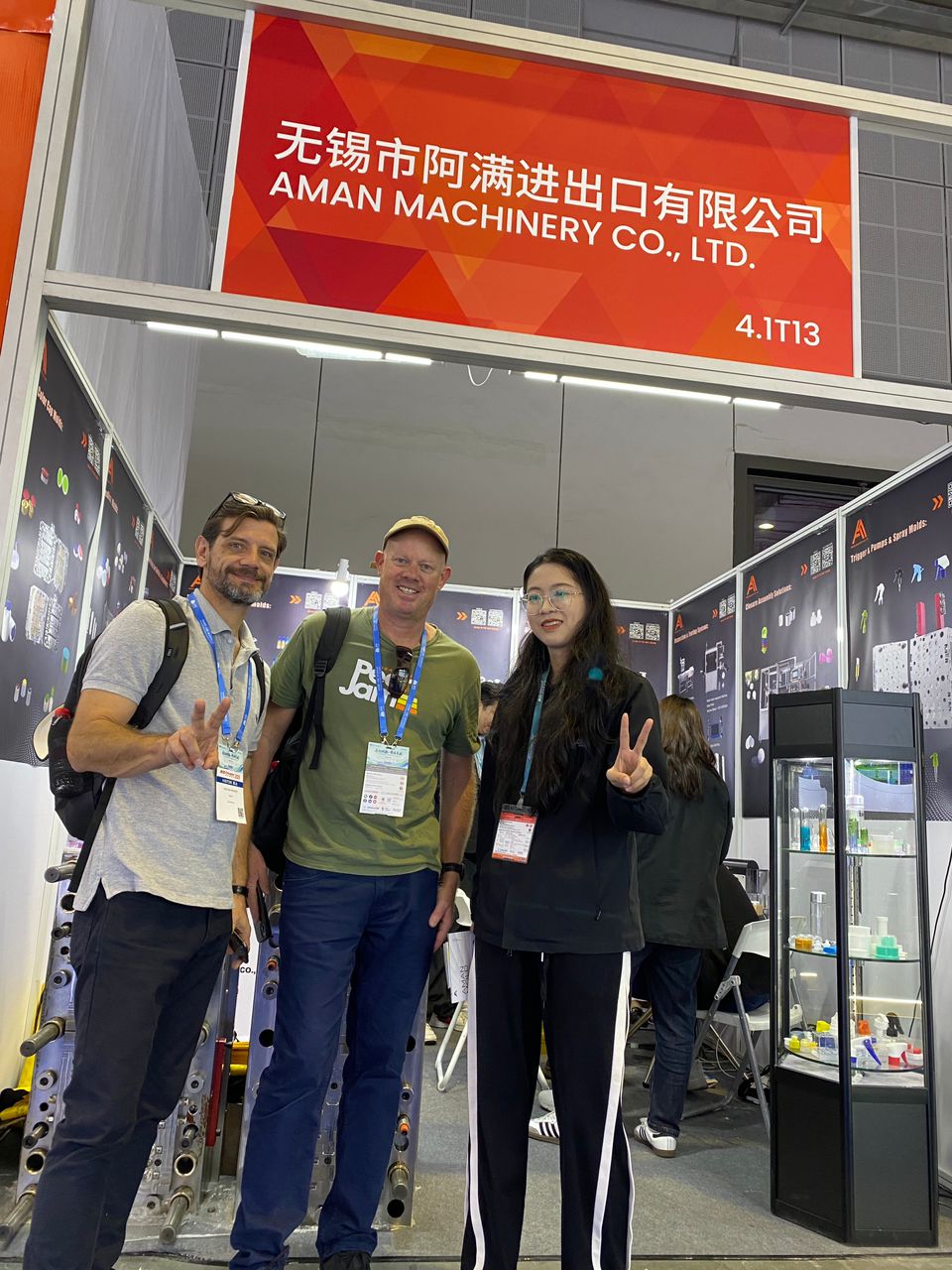
With the team at Aman Machinery Co. — one of the filling equipment suppliers we evaluated at ChinaPlas 2026, Hall 4.1
The show at a glance
ChinaPlas is structured across multiple halls by category — filling and packaging in one zone, injection moulding in another, extrusion and film further along, recycling and circular economy technologies occupying an increasingly prominent footprint compared to previous years. The scale is genuinely hard to comprehend until you're there; halls that take 20 minutes to walk end-to-end, with machinery operating at full speed on the floor.
One immediate observation: the quality gap between Chinese-manufactured machinery and European equivalents has narrowed substantially in the past five years. Servo-driven systems, touchscreen HMIs with English interfaces, CE-equivalent safety guarding, and genuine application engineering support are now standard across the leading manufacturers — not the exception.
Filling technology: what's changed
Filling equipment was our primary focus, and the developments here are significant for any business running high-viscosity chemical products.
The shift to fully servo-controlled filling heads — replacing pneumatic and cam-driven systems — has transformed what's achievable in terms of fill accuracy and recipe flexibility. Systems we evaluated were achieving ±0.5% fill accuracy on products ranging from water-thin to thick paste, with recipe changeover in under two minutes via touchscreen. For 2-part epoxy and sealant products, this matters enormously: getting the A:B ratio right isn't just a quality issue, it's a product safety and warranty issue.
"The shift to servo-controlled filling heads has transformed fill accuracy on high-viscosity products. ±0.5% is now achievable where ±2–3% was the best you could expect from pneumatic systems a decade ago."
Dual-stream simultaneous filling — where Part A and Part B are dosed into a dual-tube cartridge in a single pass — is now mature and reliable technology. The systems we inspected used independent servo motors for each stream, with load cell feedback for real-time correction. The mechanical quality of the filling heads, nozzle seals and changeover components was noticeably better than what we'd seen at equivalent price points two years ago.
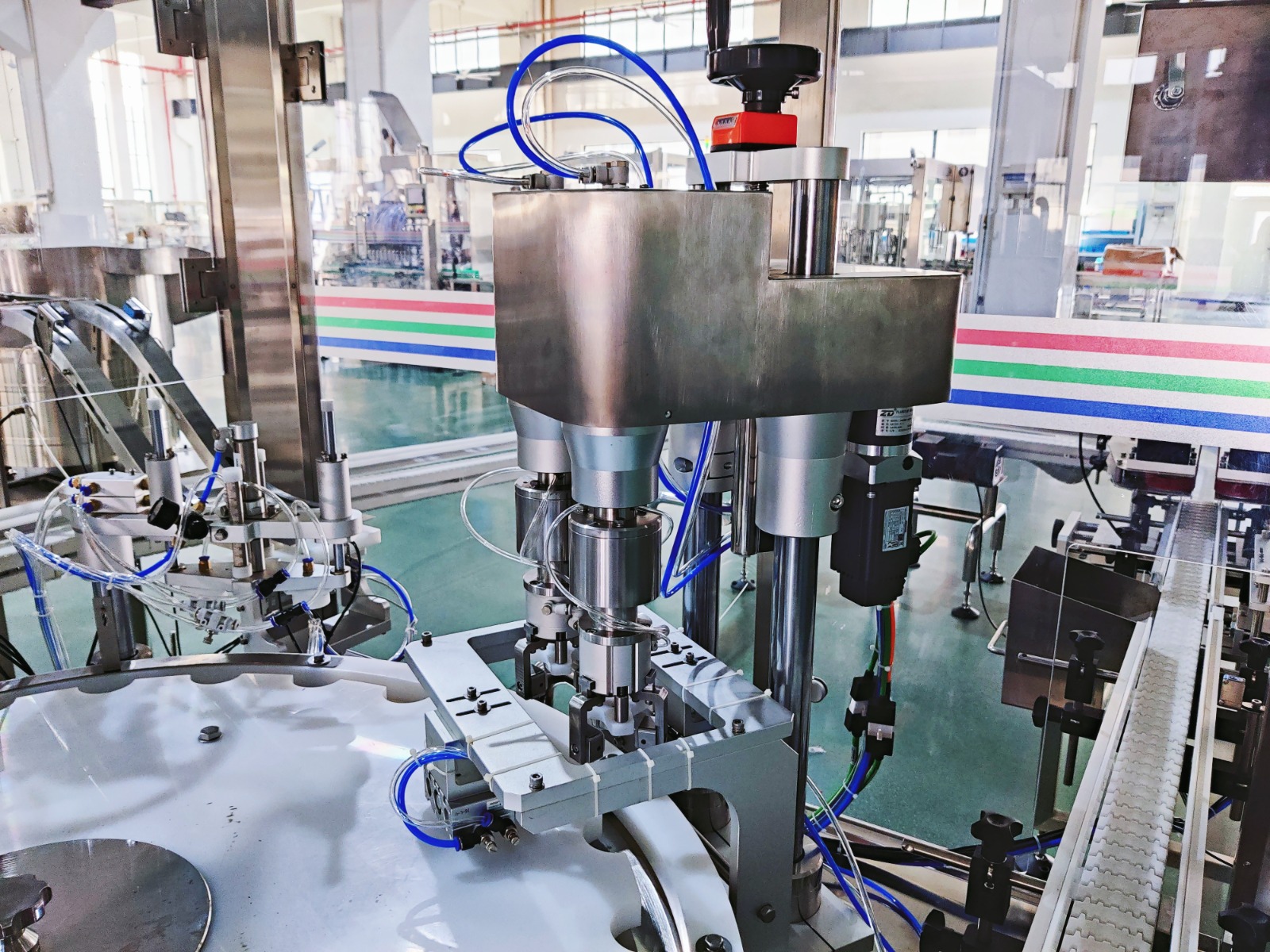
Servo-controlled dual-stream filling head — the type of machinery we're bringing to our South East Queensland filling centre
Semi-automatic lines are also more capable than their price point suggests. For lower-volume runs, new product development, or viscosity profiling on a new formulation, the semi-auto systems on show were genuinely production-quality — not entry-level compromises. Automatic cap feeding and capping were standard features, reducing operator handling and improving consistency.
One trend worth noting: integrated vision systems for fill level verification and cap detection are increasingly affordable additions to mid-range filling lines. What previously required a separate inspection station is now embedded into the line itself.
Blow moulding: servo everywhere
PET stretch blow moulding has made a similar transition. Linear servo-driven machines have largely displaced hydraulic systems in the mid-range segment, delivering faster cycle times, lower energy consumption and more consistent preform reheat profiles — all of which matter for wall thickness consistency and bottle clarity.
For HDPE extrusion blow moulding, the story is similar — servo-driven parison control is now standard on any machine worth buying. The precision in parison programming allows tighter wall thickness tolerances, which reduces material usage per bottle without compromising structural integrity. For a contract manufacturer paying for HDPE by the tonne, that's a meaningful cost saving.
We saw several manufacturers demonstrating quick-change mould systems for both SBM and EBM — reducing changeover time from hours to under 30 minutes for a complete bottle size change. For a contract manufacturer running multiple SKUs, this dramatically changes the economics of short runs.
Injection moulding: large-format servo makes sense now
Large-format PET preform injection moulding — the kind needed for 10L, 15L and 20L containers — has been a segment dominated by a small number of European brands for a long time. That's changing. Several Chinese manufacturers are now producing all-electric or hybrid servo IMMs in the 500–650 tonne clamping force range with the precision and repeatability that PET preform production demands.
The economics are compelling. A comparable European machine might cost three to four times as much for the same clamping force and plasticising capacity. The after-sales support question — historically the reason to pay the premium — is also changing, with several manufacturers now maintaining Australian service representatives and spare parts inventory.
For producing 15L preforms in-house (rather than importing them), the case is strong at current preform import prices. This is an investment we're evaluating seriously for our South East Queensland facility.
Recycling and circular economy: the fastest-moving segment
The recycling and circular economy section of ChinaPlas has grown dramatically. This isn't greenwashing on display stands — it's industrial-scale decontamination, sorting and pelletising equipment being seriously evaluated by manufacturers responding to brand-owner mandates on recycled content.
Food-grade rPET production — where post-consumer PET is decontaminated to a standard suitable for food and beverage contact — has become technically reliable at scale. Systems combining flake washing, solid-state polycondensation (SSP) and IV rebuilding can produce rPET pellets that are analytically indistinguishable from virgin material for most applications. The capital cost has come down substantially as the technology has commoditised.
For HDPE, mechanical recycling is well-established, but what's new is the integration of inline near-infrared (NIR) sorting before the wash line — dramatically improving input quality and reducing contamination issues in the final pellet. Several systems on display claimed post-consumer HDPE output suitable for non-food-contact bottles without additional purification steps.
"The recycling hall at ChinaPlas 2026 wasn't an afterthought. It was one of the busiest parts of the show — and the machines on the floor were operating at scale, not concept-stage prototypes."
Australia's soft plastics and rigid packaging recovery infrastructure is still developing, but the processing technology to do something useful with collected material is clearly ready. The bottleneck is collection and sorting, not processing.
What we came back with
We came home with supplier relationships, technical specifications, and a much clearer picture of what's commercially viable at Australian volumes. Specifically:
- Filling machinery confirmed and quotations received for our contract filling centre — servo dual-stream capability meeting the accuracy and output requirements for high-viscosity 2-part products
- Servo injection moulding options shortlisted for large-format PET preform production — investment decision pending facility confirmation
- PET stretch blow moulding and HDPE extrusion blow moulding options evaluated, with preferred suppliers identified
- A clear view on where recycled content integration is practical in the near term versus where the technology is still maturing
The trip confirmed what we suspected: the capital investment required to build a genuinely world-class filling and moulding operation in South East Queensland is lower than it's ever been, and the technology available is better than it's ever been. The constraint isn't equipment — it's demand, and that's what we're building now.
If you're a manufacturer needing filling services in SEQ
We are currently taking expressions of interest from manufacturers who need a local contract filling partner for high-viscosity 1-part or 2-part products. If you produce epoxies, sealants, polyurethanes or construction chemicals and need a reliable local filling partner, we'd like to hear from you early — before our lines are committed to existing customers.